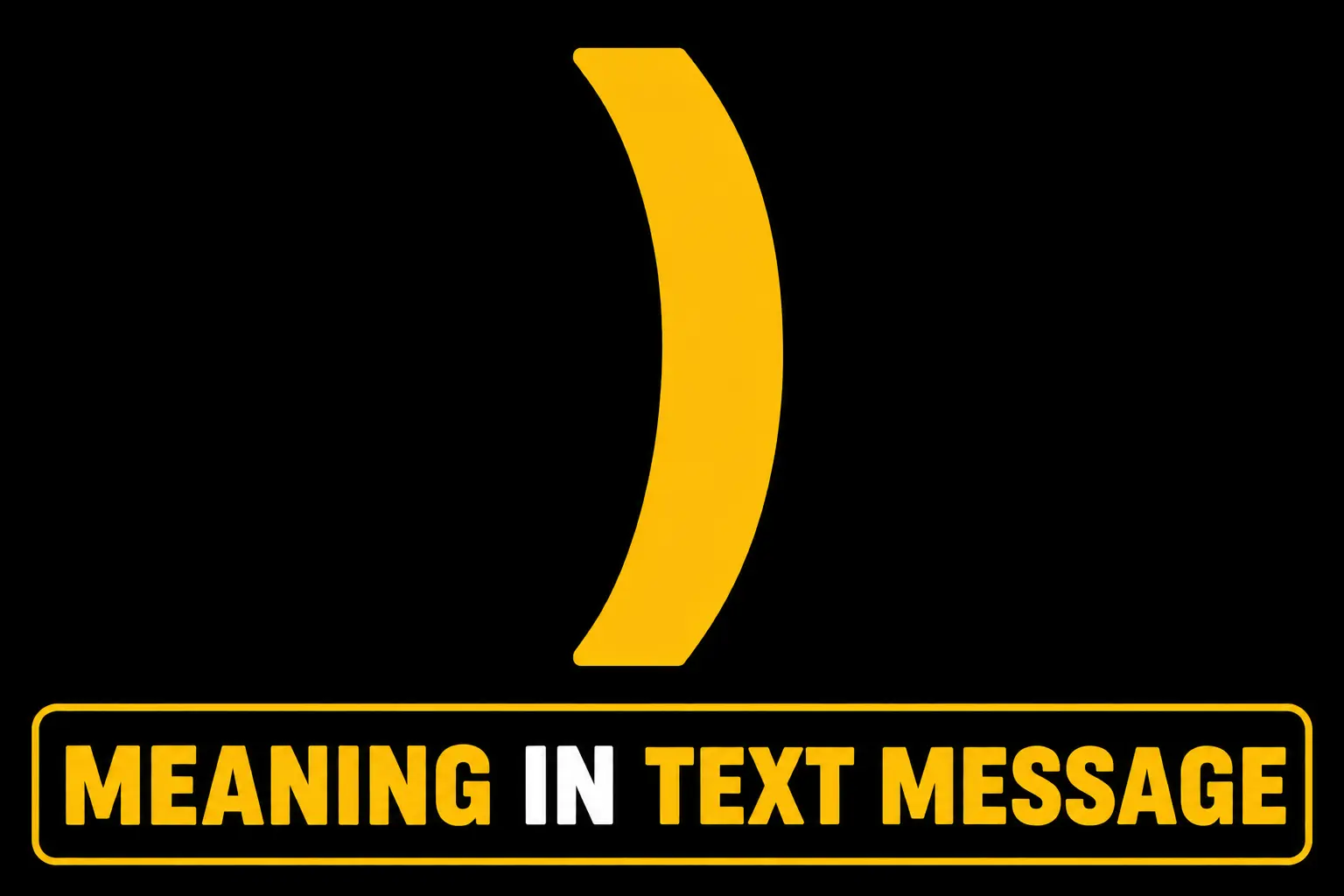
The ) meaning in text message is almost always a stripped-down smiley face — a stand-in for a smile without needing a colon or eyes in front of it. When someone sends just a closing bracket on its own, they’re usually reacting warmly to what you said, the same way you’d use 🙂 or :).
This symbol didn’t start in English texting. It came from Russian and Eastern European internet culture, where typing a full 🙂 is awkward on the keyboard layout, so people dropped the colon entirely and kept the curve. It’s since spread into English-language chats, especially among people who talk to international friends, play online games, or spend time in global Discord and gaming communities. Below, you’ll find where it comes from, how many brackets change the meaning, real examples, and what to do if you’re not sure how to read it.
Table of Contents
What Does a Lone ) Mean in Texting?
On its own, a closing parenthesis works as a minimalist smile. It’s softer and quicker than typing out a full emoticon or reaching for an emoji, and it usually signals one of these:
- A light smile or friendly acknowledgment.
- Agreement without needing extra words.
- A polite, warm tone at the end of a sentence.
The ) meaning in text message changes slightly depending on how many you see stacked together. One bracket is subtle. Several in a row is a much bigger reaction.
| Symbol | Meaning |
| ) | Light smile, polite or friendly tone |
| )) | Genuine amusement, something actually funny |
| ))) | Laughing out loud |
| )))))+ | Big laugh, sometimes sarcastic or over-the-top |
| ( | A frown or sad reaction |
| (( or more | Increasing sadness or disappointment |
Where Does This Symbol Come From?
The bracket-only smiley started in Russian-speaking internet spaces. Typing a colon on a Russian keyboard layout takes an awkward key combination, so instead of 🙂 people simplified it down to just the curve — the “)” — and it stuck. Over time, it became a signature part of Russian and Ukrainian texting style, almost like a “polite dot” at the end of a friendly message.
As gaming platforms, Discord servers, and international group chats brought more cultures together, English speakers picked it up too, especially in casual or gaming contexts where a quick “)” replaces a longer reaction.
) Meaning in Text Message by Platform
The ) meaning in text message shows up slightly differently depending on where you’re chatting.
| Platform | Typical Usage |
| Texting/SMS | Occasional, usually from someone influenced by international texting habits |
| Common in international group chats, especially with European or Russian-speaking contacts | |
| Discord | Frequent in gaming servers, often stacked as )) or ))) for a bigger laugh |
| Used in DMs as a quick, low-effort reaction | |
| Snapchat | Less common, but appears as a light acknowledgment |
| X (Twitter) | Occasionally used in replies to add a soft, friendly tone |
| Facebook Messenger | Similar to texting — casual and friendly |
Real Chat Examples
Seeing the symbol inside actual conversations makes the tone easier to read.
| Message | Likely Meaning |
| “yeah I finished it already )” | Light smile, casual confirmation |
| “))) that’s actually hilarious” | Genuine laughter |
| “sounds good, see you then )” | Friendly, polite tone |
| “))))) I can’t stop laughing” | Big laugh, very amused |
| “no worries at all )” | Warm reassurance |
| “( I missed the bus again” | Mild frustration or sadness |
| “(( today was rough” | Deeper disappointment |
| “we won the match )))” | Excited, happy reaction |
Common Replies
Responding to a lone bracket is usually just as simple.
If it felt warm or friendly:
- “)” back
- “haha same”
- “😊”
If it felt like genuine laughter:
- “))) I know right”
- “lmaooo”
If it was a sad face “(“:
- “aw no, you good?”
- “what happened?”
Common Mistakes People Make
A few misunderstandings come up often with this symbol:
- Reading it as a typo. People unfamiliar with the style sometimes think the sender forgot the colon in :). It’s intentional, not a mistake.
- Missing the count. One bracket and five brackets mean very different intensity levels — treating them the same misses the emotional cue.
- Assuming it’s always positive. A closing bracket “(” reversed direction means sad, not happy — mixing the two up flips the entire meaning.
- Ignoring the context. In some cases, a single “)” left after autocorrect changes a message can be unrelated to the smiley style entirely — check the rest of the message for clues.
Similar Slang and Symbols
The ) meaning in text message fits into a small family of quick, symbol-based reactions people use instead of full words.
| Symbol/Term | Meaning |
| ) | Light smile |
| 🙂 | Standard smiley face |
| XOXO | Hugs and kisses |
| K | Okay, often used briefly |
| OOF | Reaction to something rough or unfortunate |
| W | Win, something good happened |
Polite Alternatives
If you’d rather use something more universally understood, try:
- “:)” — the standard smiley
- “🙂” or “😊”
- “haha” or “lol”
- Simply saying “sounds good” or “that’s funny”
Quick Summary
- The ) meaning in text message is typically a simplified smiley face, especially common in Russian-influenced and international texting styles.
- More brackets in a row means a bigger reaction — one is a light smile, several is genuine laughter.
- A “(” works the opposite way, signaling sadness or disappointment.
- It’s spread from Russian internet culture into gaming chats, Discord, and casual English texting.
- If it looks like a typo, check the context — sometimes it really is just a smiley, not a mistake.
Frequently Asked Questions
What is the ) meaning in text message exactly? It’s typically a minimalist smiley face, used to show a light, friendly, or amused tone without typing a full emoticon or emoji.
Why do people use just a bracket instead of a full smiley? The style comes from Russian and Eastern European texting culture, where typing a colon before the bracket is awkward on the keyboard, so people simplified it to just the curve.
Does the number of brackets matter? Yes. One bracket is a subtle smile, while several in a row — like ))) — signals genuine laughter or a bigger reaction.
Is a closing bracket always a smiley? Not always. Occasionally it appears from an autocorrect mistake or a cut-off message, so it’s worth checking the context if it seems out of place.
What does “(” mean instead of “)”? A single or repeated opening parenthesis works as a frown, signaling sadness or disappointment rather than a smile.
Is this symbol used in the US? It’s less common than a standard 🙂 or emoji in everyday American texting, but it does show up in gaming chats, Discord, and conversations with international friends.
How should I reply to a text that just says “)”? A simple “)” back, a “haha,” or a warm reply matching the tone is usually enough — no need to overanalyze a short, friendly message.
Where did the ) smiley trend start? It originated in Russian-speaking internet communities as a shorthand alternative to the standard 🙂 emoticon, according to cultural language guides that track internet slang trends across regions.
Can too many brackets come across as sarcastic? Yes, a long string like “))))))))” can sometimes read as exaggerated or sarcastic rather than sincere, depending on the context of the conversation.
Is there a more formal way to express the same feeling? Yes — writing out “haha,” using a standard smiley face :), or simply saying what you mean works well in more formal texting situations.