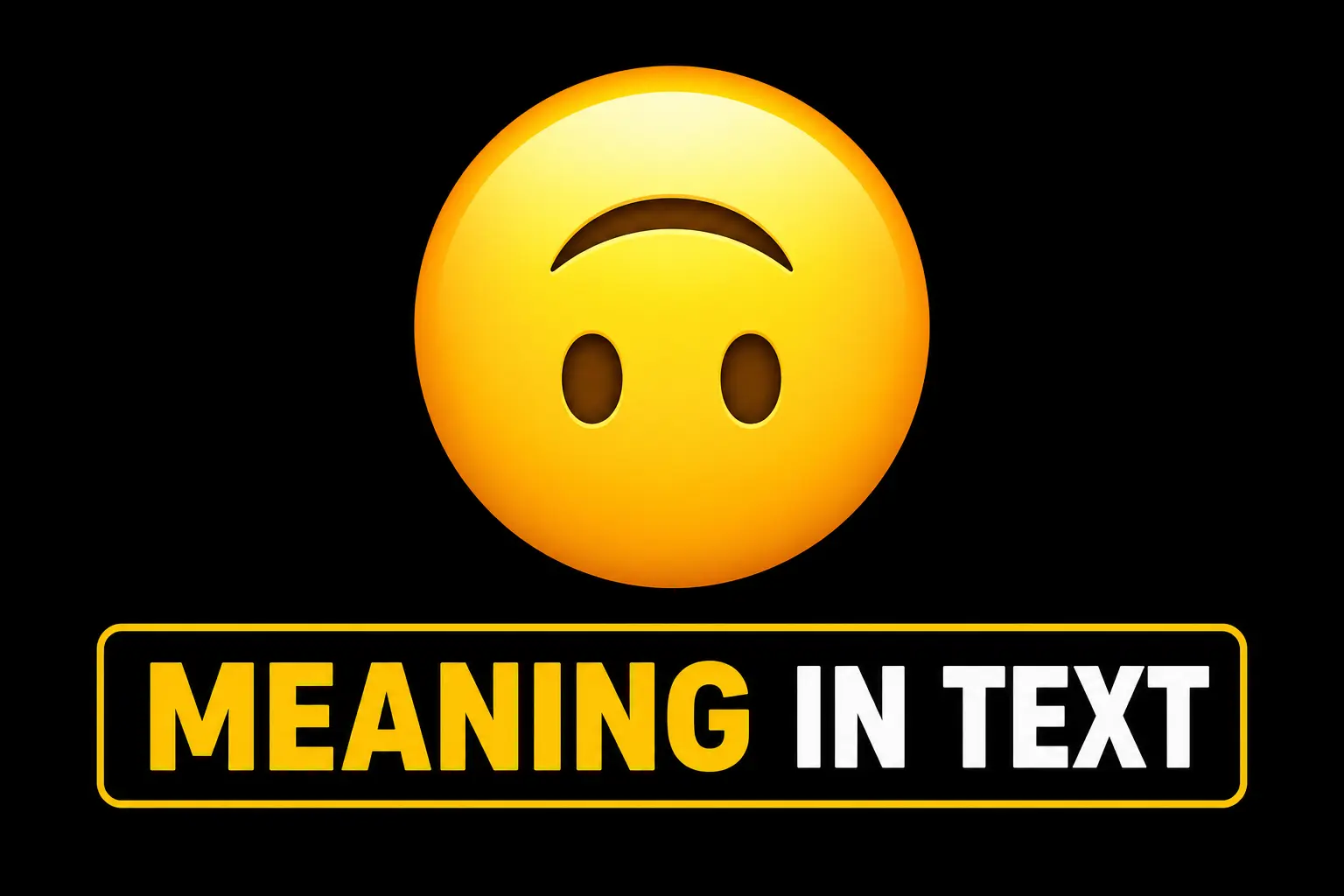
The 🙃 meaning in text almost never matches the literal image of a smiling face. Instead, this flipped smiley is one of the most tone-dependent emojis out there, used to signal sarcasm, awkward humor, quiet frustration, or “I’m smiling through this but it’s not actually great.” Reading it correctly comes down to context more than the emoji itself. This guide breaks down every real meaning behind 🙃, how to tell them apart, and how to reply without misreading the tone.
Getting a text that ends in 🙃 can leave you second-guessing what someone actually meant. That reaction is normal — this emoji was practically built for mixed signals, and figuring out which one applies takes just a few context clues.
Table of Contents
Quick Answer: What Does 🙃 Mean?
| Term | 🙃 |
| Official Name | Upside-Down Face |
| Most Common Meaning | Sarcasm or irony |
| Other Common Meanings | Silliness, awkward humor, passive frustration, “this is fine” resignation |
| Added to Unicode | 2015 (Unicode 8.0) |
| Common Platforms | Instagram, TikTok, texting, Snapchat, X/Twitter |
| Formality | Not appropriate for professional or formal use |
| Similar Emojis | 🙂 (flat smile), 😅 (nervous laugh), 🫠 (melting face) |
The Real 🙃 Meaning in Text
The upside-down face was added to Unicode back in 2015, and it filled a real gap: there wasn’t a clean way to signal “I’m saying this with a smile, but I don’t fully mean it” until this emoji showed up. That’s still its core function today. The 🙃 meaning in text works like a built-in tone marker, similar to typing “/s” for sarcasm, except it’s visual and far more flexible.
Example: “Sure, I’d LOVE to work this weekend 🙃”
Here, the flipped smile signals that the sentence should be read as the opposite of what it literally says. Nobody actually loves working weekends — the emoji does the work of making that obvious.
Why One Emoji Carries So Many Different Tones
Unlike emojis with a single clear meaning, 🙃 flexes depending on what’s being said and who’s saying it. A few consistent threads run through nearly every use, though:
- A gap between the words and the real feeling. The sentence sounds fine or neutral; the emoji signals it isn’t.
- A soft landing for something uncomfortable. It takes the edge off complaints, awkward admissions, or bad news.
- Deliberate ambiguity. Sometimes people use it specifically because they don’t want to commit to a clearer emotional tone.
Every Tone Behind the 🙃 Meaning in Text
Breaking this down by tone makes it far easier to read correctly in the moment.
1. Sarcasm
The most common use. It flips a statement’s literal meaning, similar to an eye-roll paired with a smile.
Example: “Yeah, my day was AMAZING 🙃” after clearly having a rough one.
2. Silliness or Playfulness
Sometimes there’s no hidden meaning at all — it’s just a goofy, lighthearted addition to a message.
Example: “Just ate cereal for dinner again 🙃”
3. Passive Aggression
This is where the emoji gets its reputation for feeling loaded. It can soften a pointed comment while still letting the underlying annoyance show through.
Example: “No worries, I’ll just handle it myself then 🙃”
4. Awkward Discomfort
Used when something is uncomfortable, embarrassing, or mildly humiliating, and there’s no better way to react than a slightly nervous smile.
Example: “I called my teacher ‘mom’ in class today 🙃”
5. Frustrated Resignation (“This Is Fine”)
This is the “smiling through the pain” use — acknowledging something’s genuinely not okay while still trying to stay composed.
Example: “Third meeting got rescheduled this week 🙃”
How to Decode the 🙃 Meaning in Text Every Time
Since one emoji covers this much emotional range, a few context checks make interpretation far easier.
- Read the sentence without the emoji first. If it sounds too positive to be genuine, sarcasm is likely.
- Check for a complaint or inconvenience nearby. If the message describes something annoying, the emoji is probably softening frustration.
- Look at what kind of person sent it. Some people default to 🙃 as filler punctuation with almost no deeper meaning, while others use it more deliberately.
- Consider the relationship and history. A friend who often uses 🙃 sarcastically is probably doing the same thing again; someone who rarely uses emojis at all sending one out of nowhere might be signaling real discomfort.
🙃 Meaning by Platform
| Platform | Typical Meaning | Common Use Case |
| Sarcasm or self-deprecating humor | Captions softening an awkward or funny admission | |
| TikTok | Silliness or irony | Comments reacting to something absurd or relatable |
| Texting (SMS) | Passive frustration or sarcasm | Reacting to inconvenient plans or annoying situations |
| Snapchat | Playful or ironic tone | Casual replies to snaps, often lighthearted |
| Sarcasm or resignation | Group chats reacting to shared frustrations | |
| Discord | Silliness or irony | Reacting to something chaotic or funny in a server |
| X/Twitter | Sarcasm or dry humor | Replies and quote tweets adding an ironic tone |
| Facebook Messenger | Passive frustration | One-on-one chats softening a complaint |
Real Chat Examples of 🙃 in Use
Seeing the range across different situations makes the tone much easier to spot.
- A: “How was the exam?” B: “Great, totally didn’t blank on question three 🙃”
- A: “Can you cover my shift again?” B: “Sure, why not 🙃”
- A: “Tripped in front of the whole class today 🙃”
- A: “Plans got cancelled again.” B: “Cool, love that for me 🙃”
- A: “Accidentally called my boss ‘babe’ on a call 🙃”
- A: “Third flat tire this month 🙃”
- A: “You seem stressed.” B: “Nah, I’m totally fine 🙃”
- A: “Forgot my umbrella again, obviously 🙃”
- A: “Just found out the meeting got moved to 7am 🙃”
- A: “Told him I was busy but really just didn’t want to go 🙃”
How to Reply to a 🙃 Text
Matching your reply to the actual tone behind the emoji, not just the literal words, keeps the conversation flowing naturally.
| Tone Behind 🙃 | Casual Reply | Supportive Reply |
| Sarcasm | “Lol sounds rough” | “Okay that’s clearly not amazing” |
| Silliness | “Classic you 😂” | “Iconic honestly” |
| Passive aggression | “Wait, are you actually annoyed?” | “I can help if you need it” |
| Awkward discomfort | “Oh no 😂 we’ve all been there” | “That’s mortifying, I’m sorry” |
| Frustrated resignation | “That’s genuinely so annoying” | “Are you doing okay?” |
Similar Emojis to Compare With 🙃
A few related emojis show up in the same emotionally layered, tone-dependent territory as the upside-down face.
- 🙂 (Slightly Smiling Face): Reads as neutral or even slightly passive-aggressive on its own, but lacks the sarcastic flip that 🙃 carries.
- 😅 (Downcast Face with Sweat): Leans more toward nervous relief or embarrassment than sarcasm.
- 🫠 (Melting Face): A newer way to express being overwhelmed or metaphorically “melting” from stress or secondhand embarrassment.
- 🤡 (Clown Face): Used for self-deprecating admissions of doing something foolish, often paired with 🙃 for extra emphasis.
- 🤷 (Person Shrugging): Shares some overlap with 🙃’s “oh well” resignation, though it leans more toward indifference than sarcasm.
Common Mistakes People Make With 🙃
- Assuming it’s always sarcastic. While sarcasm is common, plenty of uses are genuinely lighthearted or silly with zero hidden frustration behind them.
- Missing real distress behind the smile. Because this emoji often masks frustration or discomfort, taking it at pure face value can mean overlooking that someone’s actually having a hard time.
- Using it in professional messages. Its inherently mixed, informal tone makes it a poor fit for work emails or formal communication.
- Overreacting to a playful use. Not every 🙃 signals passive aggression — sometimes it really is just a goofy addition to a message.
- Ignoring the sender’s usual texting style. Someone who uses 🙃 constantly as filler is sending a very different signal than someone using it for the first time in a serious conversation.
Quick Summary: 🙃 Meaning in Text
- Core function: A visual tone marker, similar to writing “/s,” signaling that a message shouldn’t be taken fully at face value
- Most common uses: Sarcasm, silliness, passive frustration, awkward discomfort, and “smiling through it” resignation
- How to decode it: Read the sentence without the emoji, check for nearby complaints, and consider the sender’s usual texting habits
- Where to avoid it: Professional emails, formal writing, and serious business communication
- Best reply approach: Match the underlying tone rather than the literal words, and check in directly if genuine frustration seems likely
For more slang and expressions that carry a similarly layered, tone-dependent feel, terms like SMH and ISTG round out the same kind of emotionally expressive texting vocabulary 🙃 belongs to.
Frequently Asked Questions
What is the 🙃 meaning in text? The 🙃 meaning in text is highly context-dependent, but it most commonly signals sarcasm, irony, or a “smiling through it” attitude when something isn’t actually fine.
Is 🙃 always sarcastic? No. It can also express silliness, playful humor, awkward discomfort, or quiet frustration, depending entirely on the message around it.
Does 🙃 mean someone is upset? Sometimes. It can mask real frustration or disappointment behind a lighthearted tone, so it’s worth paying attention if the surrounding message describes something inconvenient or annoying.
When was the upside-down face emoji added? It was officially added to Unicode 8.0 in 2015, though similar upside-down smileys appeared informally on some platforms earlier.
Is it okay to use 🙃 in a professional message? No. Its ambiguous, informal tone makes it unsuitable for work emails or formal business communication.
What’s the difference between 🙃 and 🙂? 🙂 reads as neutral or mildly flat, while 🙃 adds a layer of sarcasm, irony, or hidden meaning that 🙂 doesn’t carry.
How do I know if 🙃 means my friend is actually annoyed? Look at whether the message describes something frustrating or inconvenient. If so, the emoji is likely softening real annoyance rather than being purely playful.
Can 🙃 be used flirtatiously? Yes, occasionally. In some casual, playful conversations, it can add a teasing, slightly ambiguous flirty tone similar to a smirk.
Is 🙃 considered passive-aggressive? It can be, particularly when paired with a statement that sounds overly agreeable in a situation where agreement seems unlikely.
What’s a safe way to reply if I’m unsure what someone meant by 🙃? A simple, direct question like “wait, are you actually okay?” works well when the tone feels unclear, without assuming the wrong meaning.