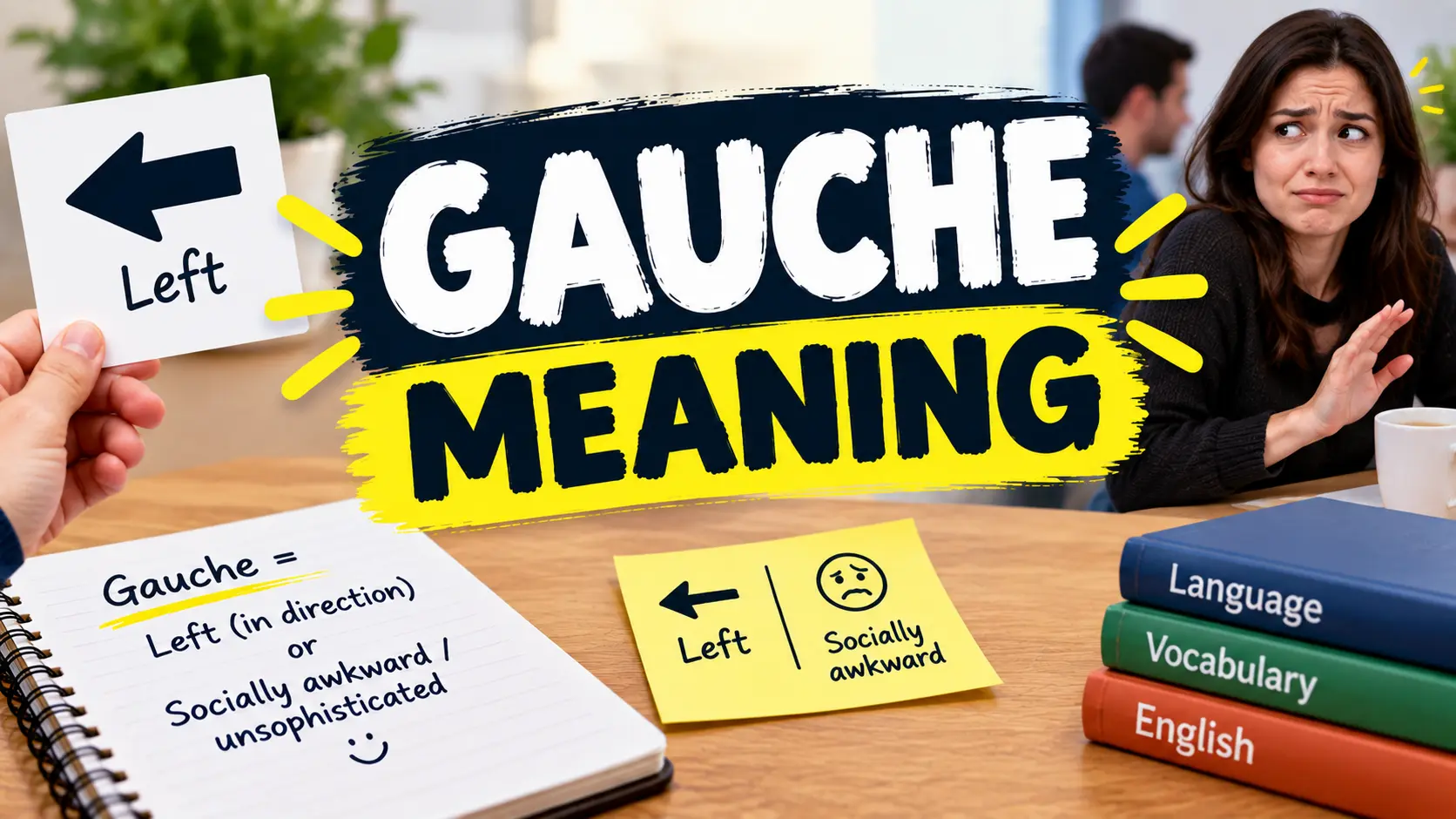
The gauche meaning boils down to one idea: socially awkward, tactless, or lacking polish, usually in a way that feels a little embarrassing to witness. It’s a borrowed French word that made its way into English etiquette-speak in the 1700s and never left. This guide covers exactly how to pronounce it, where it came from, how to use it in a real sentence without sounding like you’re forcing a vocabulary word, and where people commonly trip up — including a lesser-known technical meaning in math and chemistry that most definitions skip entirely.
Table of Contents
Gauche Meaning: The Straightforward Definition
Gauche describes someone or something that’s clumsy in a social sense — not physically clumsy, but awkward in manner, tactless in conversation, or unrefined in a way that stands out. It’s most often used to describe behavior, comments, or choices that show a lack of social experience or good judgment about what’s appropriate.
A few dictionary-level synonyms line up closely with the gauche meaning: unsophisticated, tactless, crude, and lacking in social grace. It’s a step beyond simply “awkward” — gauche usually implies the person should have known better, or that the moment called for more polish than they delivered.
How to Pronounce Gauche
This trips people up constantly, so it’s worth settling first. Gauche is pronounced “gohsh” — rhyming with “gosh,” but with a long O sound, close to how you’d say “go” followed by “sh.” It’s one syllable: /ɡoʊʃ/. It is not “gowch,” “gotch,” or pronounced like “gouge.” If you’ve seen the word “gouache” (the paint) and assumed they sound alike, they don’t — gouache is pronounced “gwahsh,” a different word with a different, unrelated origin.
Where the Word Comes From
Gauche is a direct borrow from French, where it literally means “left” — as in the left side, left hand, or left-handed. English speakers adopted it in the mid-1700s specifically for its figurative sense: awkward, clumsy, tactless. The connection between “left” and “awkward” isn’t random. For centuries, left-handedness was treated with suspicion in many cultures, and right-handedness was linked to skill and correctness — which is also why “adroit” (skillful) comes from the French for “right,” and “sinister” traces back to the Latin word for “left.”
So the gauche meaning carries a small piece of that old bias baked in: it’s a word built on the historical assumption that “left” equals “wrong” or “clumsy,” even though it now applies to anyone regardless of handedness.
How to Use Gauche in a Sentence
Gauche almost always describes behavior, comments, or choices — rarely physical objects, and never physical clumsiness like tripping over a rug. Here’s what natural usage looks like:
- “Asking about her salary at dinner was incredibly gauche.”
- “He thought the joke was funny, but the room found it gauche.”
- “Wearing white to someone else’s wedding is a classic gauche move.”
- “The ad campaign came across as gauche rather than clever.”
- “She has impeccable manners; nothing she does is ever gauche.”
Notice the pattern: gauche criticizes judgment and social awareness, not physical skill. Someone who spills a drink isn’t gauche — someone who makes a loud comment about it in front of the host might be.
Gauche Meaning Summary Table
| Aspect | Detail |
| Part of speech | Adjective |
| Pronunciation | “gohsh” (rhymes with “gosh,” long O) |
| Origin | French, literally “left”; adopted into English by the 1750s |
| Core meaning | Socially awkward, tactless, lacking polish or refinement |
| Applies to | Behavior, comments, choices, manners |
| Opposite | Adroit, suave, polished, sophisticated |
The Technical Meaning Most Guides Skip
Outside of etiquette, gauche has a specific technical sense in chemistry and geometry that’s worth knowing if you’ve run into it in a science class. In organic chemistry, a “gauche conformation” describes two groups on adjacent atoms positioned about 60 degrees apart when you look down the bond connecting them — as opposed to an “anti” conformation, where they sit roughly 180 degrees apart. This use has nothing to do with manners; it’s a leftover from the same French root simply meaning “off to the side” or “at an angle,” repurposed by chemists to describe molecular geometry. If you’ve only encountered the etiquette sense, this is the kind of detail that shows the word’s reach goes further than a dinner-party insult.
Realistic Examples: How People Use “Gauche” Today
The word shows up more in writing, book reviews, and vocabulary-focused social content than in casual texting, but it does appear in conversation among people who enjoy precise language — including a lot of BookTok and word-of-the-day style posts.
| Message or Caption | What It Means |
| “New vocab word I’m obsessed with: gauche. Use it in a sentence below” | Sharing the word as a vocabulary-building trend |
| “That comment about her divorce was so gauche” | Criticizing a tactless remark |
| “Bringing a date to a funeral? Gauche.” | Calling out socially inappropriate behavior |
| “Her outfit wasn’t gauche, it was actually kind of iconic” | Defending a choice against an accusation of poor taste |
| “I love how ‘gauche’ just sounds like the insult it is” | Commenting on the word’s tone |
| “He asked how much the house cost. So gauche.” | Flagging an intrusive or tactless question |
| “This restaurant review called the decor gauche and I can’t stop laughing” | Using the word in a critical review context |
| “Not to be gauche, but can I ask what you paid for that?” | Self-aware use before saying something potentially tactless |
Common replies you’ll see under posts like these: “Adding this to my vocabulary,” “This is my new favorite insult,” or “Using this at brunch tomorrow.” If you’re building out a wider vocabulary of precise, slightly formal words people love dropping into conversation, related pages like pedantic meaning, condescending meaning, and nonchalant meaning cover the same territory — sharp, specific words for social behavior.
Common Mistakes People Make With Gauche
- Mispronouncing it. “Gowch” and “gotch” are the most common errors — the correct sound is closer to “gohsh.”
- Confusing it with “gouache.” One’s a word about tact, the other is a type of opaque watercolor paint. Different origin, different pronunciation, unrelated meaning.
- Applying it to physical clumsiness. Gauche describes social missteps, not tripping, dropping things, or general physical coordination.
- Treating it as a synonym for “rude.” Gauche implies a lack of polish or awareness more than deliberate rudeness — someone can be gauche without meaning any harm.
- Overusing it in casual speech. Because it’s a slightly formal, literary word, dropping it into every sentence can come across as trying too hard rather than precise.
Gauche vs. Similar Words
| Word | How It Differs From Gauche |
| Awkward | Broader term; can describe physical clumsiness or social discomfort, not just tactlessness |
| Tactless | Focuses specifically on insensitive comments; gauche covers a wider range of social misjudgment |
| Uncouth | Implies a lack of refinement tied to upbringing or manners generally, often harsher in tone |
| Maladroit | Very close in meaning, but more commonly used for clumsy handling of a situation or task |
| Boorish | Implies rudeness and insensitivity to others, often more aggressive than gauche |
| Adroit (opposite) | Skillful and socially graceful — literally French for “right,” the direct opposite of gauche |
Is Gauche a Formal or Casual Word?
It leans formal. You’ll encounter it far more often in writing — book reviews, etiquette columns, opinion pieces, dictionary “word of the day” features — than in everyday spoken conversation. That said, it has a strong presence in vocabulary-building communities online, where people enjoy collecting precise, slightly old-fashioned words specifically because they sound sharper than their plain-English equivalents. Using it correctly, and sparingly, signals command of language rather than pretension; using it constantly tends to have the opposite effect.
Quick Summary
- Gauche means socially awkward, tactless, or lacking refinement — it describes behavior and judgment, not physical clumsiness.
- It’s pronounced “gohsh,” borrowed directly from French, where it literally means “left.”
- The word entered English in the 1750s and carries an old cultural bias linking “left” with “clumsy.”
- It has a separate, unrelated technical meaning in chemistry describing molecular geometry.
- Its opposite is “adroit,” fittingly derived from the French word for “right.”
Frequently Asked Questions About Gauche Meaning
What is the gauche meaning in simple terms? It means socially awkward, tactless, or lacking polish — usually describing a comment, choice, or behavior rather than a person’s physical actions.
How do you pronounce gauche? It’s pronounced “gohsh,” rhyming with “gosh” but with a longer O sound. It is not pronounced like “gouge” or “gotch.”
Is gauche a compliment or an insult? It’s an insult, though typically a mild, somewhat witty one rather than a harsh one. It criticizes a lack of social awareness rather than character.
What’s the opposite of gauche? Adroit is the closest direct opposite, meaning skillful and socially graceful. Suave and polished work as looser opposites too.
Is gauche the same as gouache? No. Gouache is a type of opaque watercolor paint, pronounced “gwahsh,” with a separate origin. The words only look alike on the page.
Can gauche describe physical clumsiness? Not typically. It’s reserved for social or behavioral clumsiness — tactless comments, poor judgment, or a lack of refinement — rather than physically bumping into things.
Where does the word gauche come from? It comes from French, where it literally means “left.” English adopted it in the mid-1700s for its figurative sense of awkward or tactless.
Does gauche have a meaning outside of etiquette? Yes. In chemistry, a “gauche conformation” describes a specific molecular arrangement where two groups sit about 60 degrees apart around a bond.
Is it okay to use gauche in casual conversation? Yes, though it reads as a slightly formal or literary word. Using it occasionally lands well; overusing it can come across as trying too hard.
What’s a good example sentence using gauche? “Asking a stranger how much they paid for their house is considered gauche in most social settings” is a natural, accurate use of the word.