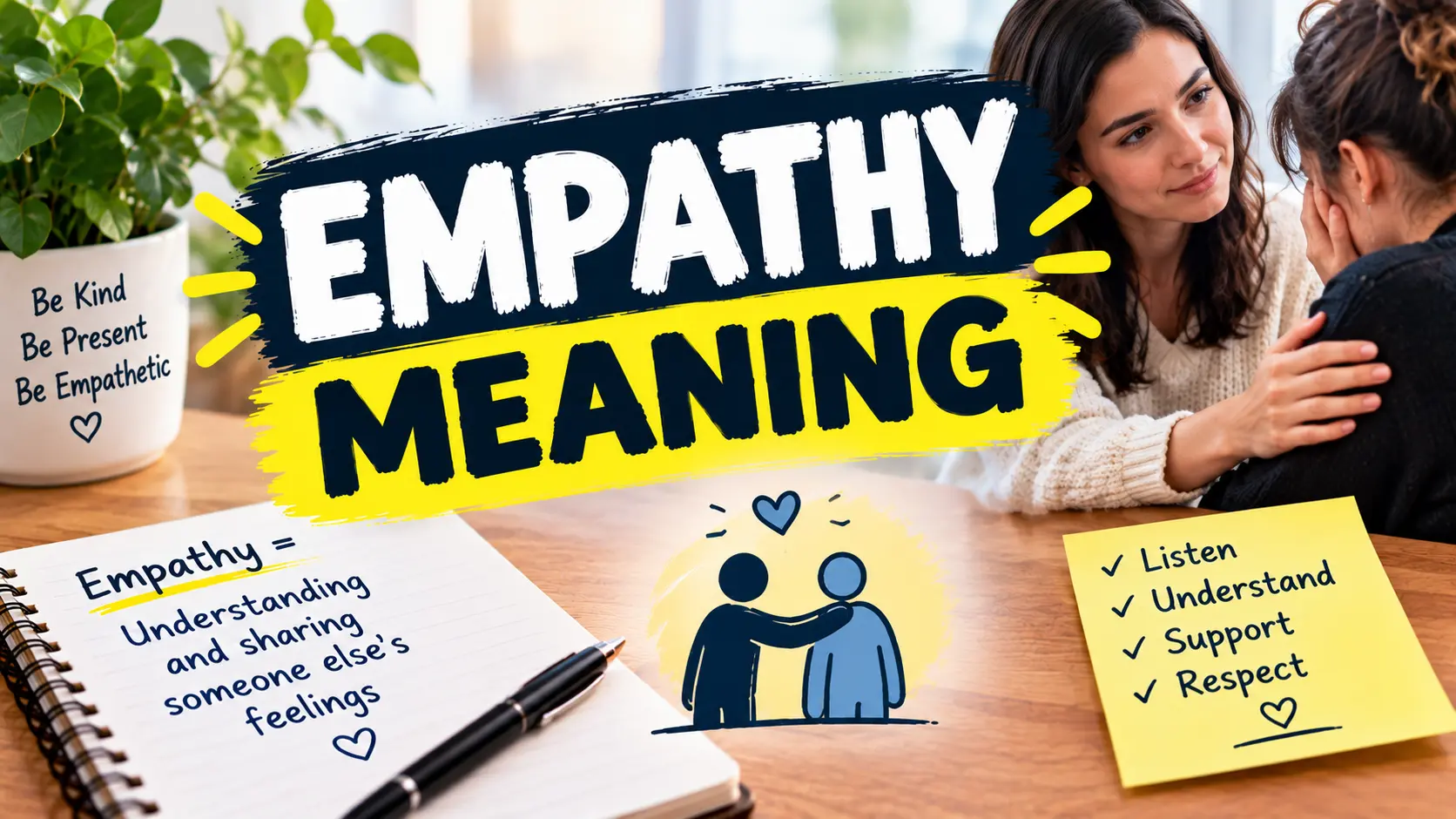
The empathy meaning most people are searching for goes beyond “feeling bad for someone” — empathy is the ability to understand and, to some degree, share what another person is experiencing from their point of view. It’s a skill built on perspective-taking and emotional attunement, not just a passing reaction. This guide breaks down where the word comes from, the three distinct types psychologists actually study, how empathy differs from sympathy and compassion, what it looks like in real conversations, and where people commonly get it wrong.
Table of Contents
Empathy Meaning: The Straightforward Definition
At its core, empathy is the capacity to recognize, understand, and vicariously experience the feelings, thoughts, or perspective of another person — as if you’re momentarily seeing the situation through their eyes rather than just observing it from your own.
That’s the technical empathy meaning used across psychology, but the everyday version is simpler: it’s what happens when someone’s pain, joy, or frustration genuinely registers with you, not just as information, but as something you can imagine feeling yourself.
Where the Word Comes From
Empathy is younger than most people assume. It was coined in the early 1900s as an English translation of the German word Einfühlung, meaning “feeling into” — a term originally used in art and aesthetics to describe how a viewer projects feeling into a painting or sculpture. Psychologist Edward Titchener imported the term into English in 1909, and it slowly shifted from an art-criticism concept into the psychological term we use today.
That’s a notably recent origin compared to “sympathy,” which traces back centuries further to Greek roots meaning “feeling with.” The empathy meaning we use now essentially took over ground that sympathy used to cover, while sympathy narrowed into something closer to concern or pity.
Empathy vs. Sympathy vs. Compassion
This is the comparison people search for constantly, and it’s worth being precise about, because the three words get used interchangeably even though they describe different things.
| Term | What It Actually Means |
| Empathy | Understanding and sharing another person’s feelings, as if experiencing them from their perspective |
| Sympathy | Feeling concern, sorrow, or pity for someone’s situation, without necessarily sharing the feeling itself |
| Compassion | A caring response that includes wanting to help relieve someone’s suffering, often building on empathy |
A simple way to separate them: sympathy is feeling for someone, empathy is feeling with someone, and compassion adds the drive to actually do something about it.
The Three Types of Empathy
Psychologists generally break the empathy meaning down into three distinct forms, popularized largely through the work of psychologist Daniel Goleman. Each one shows up differently in real interactions.
Cognitive Empathy
Understanding what someone else is thinking or feeling without necessarily feeling it yourself. This is sometimes called “perspective-taking” — you can accurately predict how someone feels and why, even if you’re not emotionally affected yourself.
Emotional (Affective) Empathy
Actually feeling what another person feels, sometimes described as an emotional mirroring effect. If a friend is anxious and you start to feel a version of that anxiety yourself just from being around them, that’s emotional empathy at work.
Compassionate Empathy
Understanding someone’s feelings, sharing in them to some degree, and being moved to actually help. This is the type most associated with meaningful support — it combines the first two with action.
Empathy Meaning Summary Table
| Type | What It Involves | Example |
| Cognitive empathy | Understanding someone’s perspective without feeling it | Recognizing why a coworker is stressed before a deadline |
| Emotional empathy | Feeling a version of what someone else feels | Tearing up watching a friend cry, without knowing exactly why |
| Compassionate empathy | Understanding, feeling, and taking action | Sitting with a grieving friend and helping with practical tasks |
| Dark empathy (studied concept) | Understanding others’ emotions while using that insight for personal gain | Manipulating someone by predicting their emotional reaction |
How People Talk About Empathy in Real Life
Empathy comes up constantly in group chats, mental health conversations, and social captions — often in a more casual register than the clinical definition suggests.
| Message or Caption | What It Means |
| “Thanks for listening, that meant a lot. You always show up with empathy” | Appreciating someone’s supportive, understanding response |
| “I felt so much empathy watching that documentary, I couldn’t stop thinking about it” | Emotional empathy triggered by someone else’s story |
| “He’s smart but has zero empathy for how his words land” | Criticizing a lack of emotional awareness toward others |
| “Practicing empathy this year instead of jumping to advice” | A personal goal around listening before problem-solving |
| “She has so much empathy for her patients, it’s why she’s good at her job” | Describing a professional strength |
| “I’m exhausted, I think I’m dealing with empathy fatigue” | Referring to burnout from absorbing others’ emotions repeatedly |
| “Not to sound harsh, but I don’t think he has real empathy, just good timing” | Distinguishing between genuine and performed emotional response |
| “Empathy over judgment, always” | A values-based caption or personal philosophy statement |
Typical replies you’ll see under posts like these: “This is something I’m working on too,” “Needed this reminder today,” or “Empathy fatigue is so real.” The word shows up frequently alongside related emotional-intelligence vocabulary — for people building out that vocabulary, related pages like gaslighting meaning and narcissist meaning cover terms that often get discussed in the same conversations about relationships and emotional dynamics.
What Empathy Looks Like in Practice
Empathy isn’t just a feeling — it shows up in specific, learnable behaviors:
- Active listening — giving someone your full attention without planning your response while they’re still talking
- Reflecting back — saying something like “that sounds really frustrating” to show you’ve registered how they feel, not just what they said
- Asking, not assuming — checking what someone needs rather than deciding for them
- Sitting with discomfort — staying present during someone’s difficult moment instead of rushing to fix it or change the subject
- Withholding immediate judgment — trying to understand the reasoning behind someone’s feelings before reacting to them
Common Mistakes People Make With Empathy
- Confusing empathy with agreement. You can understand exactly why someone feels a certain way without agreeing with their conclusion or decision.
- Jumping straight to advice. Offering solutions before someone feels heard often reads as dismissive, even when the advice is good.
- Assuming empathy means absorbing someone else’s emotions entirely. Healthy empathy includes enough emotional distance to stay useful, rather than becoming overwhelmed yourself.
- Treating empathy as purely innate. It’s partly a skill that can be strengthened through practice, not just a fixed trait some people have and others don’t.
- Mistaking performative concern for real empathy. Saying the right words without genuine attention or follow-through isn’t the same as actually empathizing.
Can Empathy Be Learned?
Yes, at least in part. Cognitive empathy in particular responds well to practice — deliberately imagining someone else’s perspective, asking better questions, and slowing down before reacting all build the skill over time. Emotional empathy has a stronger biological and temperamental component, but even that can shift with consistent effort, exposure to different perspectives, and reduced stress, since chronic stress and burnout measurably reduce people’s capacity to empathize with others. Empathy isn’t simply something you either have or lack for life — it fluctuates with mental load, relationships, and how much practice you put into it.
Similar and Related Terms
| Term | How It Differs From Empathy |
| Sympathy | Concern or sorrow for someone, without necessarily sharing the feeling |
| Compassion | Empathy plus a motivation to help |
| Emotional intelligence | A broader skill set that includes empathy alongside self-awareness and emotional regulation |
| Perspective-taking | Essentially another name for cognitive empathy specifically |
| Empathy fatigue | Emotional exhaustion from repeated, sustained empathic engagement, common in caregiving roles |
Quick Summary
- Empathy means understanding and sharing another person’s feelings from their perspective, not just observing them.
- The word was coined in the early 1900s from the German Einfühlung, meaning “feeling into.”
- Psychologists distinguish cognitive, emotional, and compassionate empathy as three related but separate skills.
- Empathy differs from sympathy (concern without shared feeling) and compassion (empathy plus action).
- It’s partly learnable — active listening, reflecting feelings back, and reducing burnout all strengthen it over time.
Frequently Asked Questions About Empathy Meaning
What is the empathy meaning in simple terms? It means understanding and, to some degree, sharing what another person is feeling, as if you’re seeing their situation from their point of view rather than just your own.
What’s the difference between empathy and sympathy? Sympathy is feeling concern or sorrow for someone’s situation. Empathy goes further, involving actually understanding and sharing the feeling itself.
Is empathy the same as compassion? Not exactly. Compassion builds on empathy by adding a motivation to help relieve someone’s suffering, not just understand or share it.
Can you have too much empathy? Yes. Intense, sustained emotional empathy without enough boundaries can lead to burnout or empathy fatigue, especially in caregiving or high-stress support roles.
Is empathy something you’re born with or something you learn? Both. There’s a temperamental component, but cognitive empathy especially can be strengthened through deliberate practice like active listening and perspective-taking.
What are the three types of empathy? Cognitive empathy (understanding), emotional empathy (feeling), and compassionate empathy (understanding, feeling, and acting to help).
What does “empathy fatigue” mean? It describes emotional exhaustion that builds up from repeatedly engaging with other people’s distress, common among caregivers, therapists, and support workers.
Why do some people seem to lack empathy? Empathy capacity varies for many reasons, including stress levels, personal experience, and individual temperament — it’s a spectrum rather than a fixed trait everyone has equally.
What is “dark empathy”? A concept in psychology describing someone who can accurately read others’ emotions but uses that understanding for manipulation or personal gain rather than genuine care.
How can I show more empathy in conversations? Focus on listening fully before responding, reflect back what you hear, ask what the person actually needs, and resist the urge to immediately offer solutions.