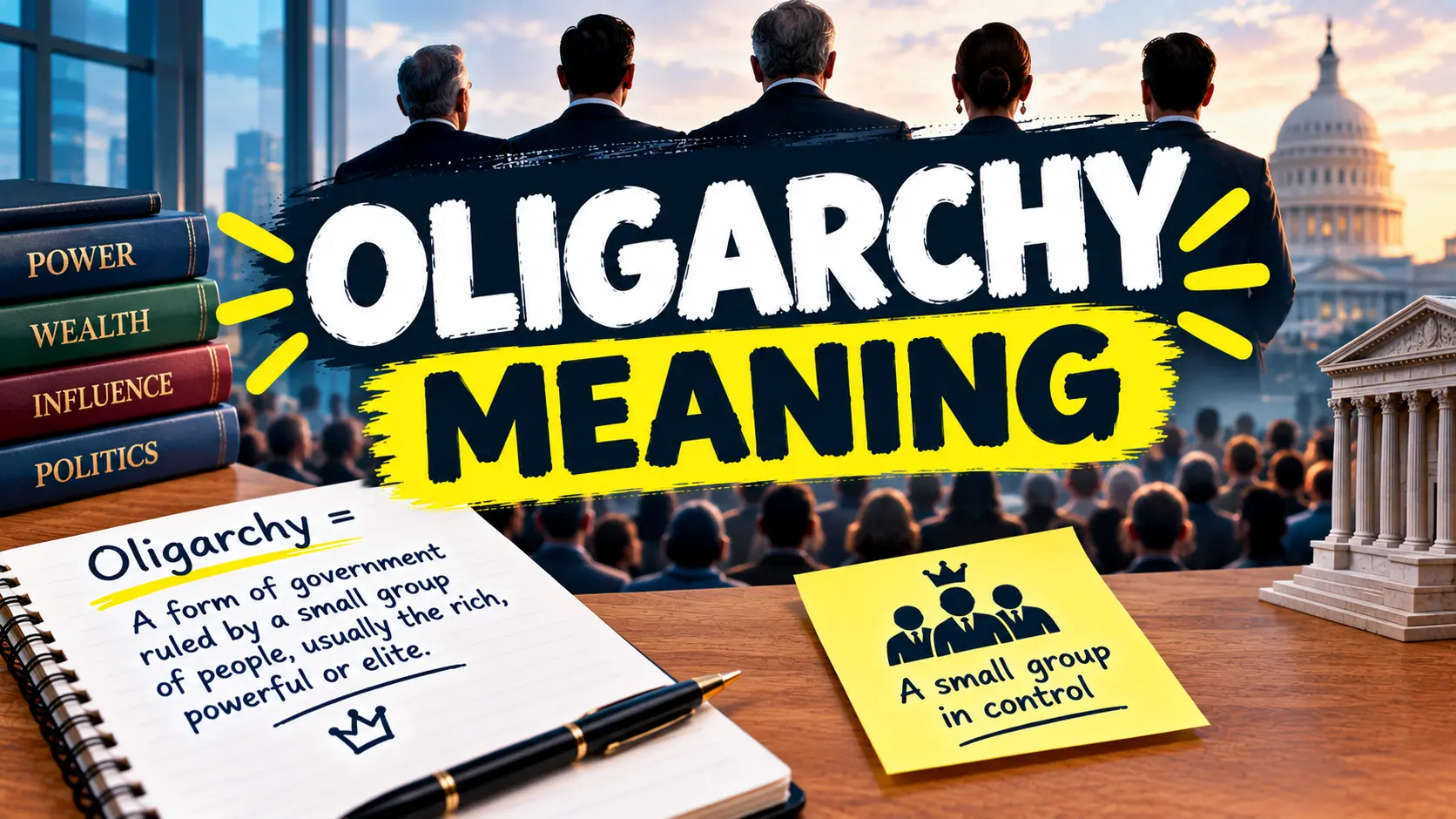
The oligarchy meaning comes down to a simple structural idea: a system where political or economic power sits in the hands of a small group rather than being spread across the population. The word comes from ancient Greek and has carried a mostly negative connotation since Aristotle first classified it more than 2,000 years ago. This guide covers the exact definition, where the concept originated, how it differs from related terms like plutocracy and aristocracy, clear historical and modern examples, and how the term shows up in current political debate.
Table of Contents
Oligarchy Meaning: The Straightforward Definition
An oligarchy is a system of government or organizational control where power is concentrated in the hands of a small group, rather than distributed broadly among citizens or members. That small group can be defined by wealth, family lineage, military control, religious authority, or membership in a particular political or economic class — the defining feature is the concentration of power, not any one specific source of it.
That’s the core oligarchy meaning used across political science today. It applies to countries, but the term also gets used more loosely to describe corporations, organizations, or institutions where a small inner circle makes most of the real decisions, even if a wider group formally exists.
Where the Word Comes From
Oligarchy comes directly from Greek: oligos, meaning “few,” and arkhein, meaning “to rule.” Put together, it literally translates to “rule by the few.” The concept dates back to ancient Greek political thought, where city-states like Sparta and Corinth were structured around rule by a small elite class, standing in direct contrast to Athenian democracy’s broader citizen participation.
The philosopher Aristotle formalized the term in his work Politics, where he classified oligarchy as a “corrupted” or “deviant” version of aristocracy. In Aristotle’s framework, aristocracy meant rule by a virtuous few working toward the common good, while oligarchy meant rule by a wealthy few working primarily for their own benefit. That negative framing has stuck with the word for over two thousand years — describing something as an oligarchy is rarely neutral or complimentary.
How Oligarchy Differs From Similar Political Terms
This comparison is where a lot of confusion comes from, since these terms get used loosely and interchangeably in casual conversation.
| Term | What It Specifically Means |
| Oligarchy | Power concentrated in a small group, regardless of what defines that group |
| Plutocracy | A specific type of oligarchy where the ruling few are defined by wealth |
| Aristocracy | Rule by a hereditary or noble elite, historically framed as working toward the common good |
| Monarchy | Rule by a single individual, typically a king or queen |
| Democracy | Political power distributed among the broader citizenry, typically through elections |
| Autocracy | Rule by a single person with unlimited or near-unlimited authority |
The key distinction to remember: plutocracy is a specific kind of oligarchy (rule by the wealthy specifically), while oligarchy is the broader category that could include rule by military leaders, party elites, landowners, or any other small, entrenched group.
Oligarchy Meaning Summary Table
| Aspect | Detail |
| Word origin | Greek, from oligos (few) + arkhein (to rule) |
| Core definition | Political or organizational power concentrated in a small group |
| Coined/classified by | Aristotle, in Politics, as a corrupted form of aristocracy |
| Defining feature | Restricted access to power, not any single specific criterion |
| Common ruling classes | Wealthy elites, military leaders, hereditary nobility, party officials |
| Compatible with elections? | Yes — oligarchy and formal democratic structures can coexist |
Historical Examples of Oligarchy
Looking at clear historical cases helps make the abstract definition concrete:
- Ancient Sparta — governed by a small council of elders and two hereditary kings, with political participation tightly restricted
- The Venetian Republic — for centuries, political power was legally restricted to a closed group of noble families listed in the “Golden Book”
- Apartheid-era South Africa — political power was formally restricted to the white minority population, a widely cited modern example of oligarchic structure
- The Soviet Politburo — a small, centralized group of Communist Party officials held effective control over Soviet governance despite the country’s formal structures
- Post-Soviet Russia in the 1990s — a small group of businessmen (commonly called “the oligarchs”) gained outsized control over major industries and, by extension, significant political influence
These examples span different centuries, ruling classes, and justifications, but they all fit the same underlying structure: a narrow group holding power that the broader population doesn’t meaningfully share.
Is the Word Used in Modern Political Debate?
Yes, and this is one of the most common reasons people search for the oligarchy meaning today. The term gets applied to modern democracies, including the United States, by commentators and some political scientists who argue that concentrated wealth and lobbying influence give a small economic elite disproportionate control over policy outcomes, even within a formally democratic system. A widely cited 2014 academic study by political scientists Martin Gilens and Benjamin Page found that economic elites and organized interest groups had substantially more influence over U.S. policy outcomes than average citizens, a finding some have pointed to as evidence of oligarchic tendencies.
Other political scientists and commentators dispute that framing, arguing that regular elections, an independent judiciary, a free press, and competitive political parties are meaningful checks that distinguish modern democracies from historical oligarchies, even where wealth clearly shapes political outcomes to some degree. Whether a specific country should be labeled an oligarchy is a genuinely contested question among researchers and political commentators, not a settled matter — the term functions more as a diagnostic lens applied to real democratic institutions than as a simple yes-or-no category.
Common Mistakes People Make With the Term
- Assuming oligarchy always means no elections exist. Oligarchic influence can coexist with formal democratic structures and regular voting.
- Treating oligarchy and plutocracy as identical. Plutocracy specifically means rule by the wealthy; oligarchy is the broader term covering any small ruling group.
- Using it as a synonym for any government someone dislikes. The term has a specific structural meaning about concentrated power, not just general criticism of leadership.
- Assuming it only applies to entire countries. The term is also used, accurately, to describe concentrated control within companies, unions, and other large organizations.
- Ignoring the historical origin. Understanding that Aristotle framed oligarchy as a corrupted form of aristocracy explains why the term almost never carries a positive connotation.
Similar Terms and How They Differ
| Term | Key Distinction From Oligarchy |
| Kleptocracy | Rule by a small group primarily focused on personal enrichment through corruption |
| Timocracy | Rule based on property ownership or honor, an older Greek classification distinct from wealth-based oligarchy |
| Junta | Specifically refers to a small group that seized power, often through military force |
| Technocracy | Rule by experts or technical specialists, based on expertise rather than wealth or lineage |
| Meritocracy | Power or advancement based on ability and achievement, structurally the opposite ideal of restricted access |
Oligarchy in Non-Political Contexts
Outside of government, “oligarchy” is used accurately to describe any organization where a small group holds disproportionate control over decisions that formally belong to a much larger body. This shows up in corporate governance (a handful of major shareholders controlling company direction), certain labor unions (leadership entrenchment despite democratic structures on paper), and even academic or professional associations. Sociologist Robert Michels described this tendency as the “iron law of oligarchy,” arguing that large organizations of almost any kind tend to develop small, entrenched leadership groups over time, regardless of their founding democratic ideals.
Quick Summary
- Oligarchy means rule by a small group, coming from the Greek for “few” and “to rule.”
- Aristotle classified it as a corrupted form of aristocracy, rule by the wealthy few for their own benefit rather than the common good.
- Plutocracy is a specific type of oligarchy defined by wealth; oligarchy is the broader umbrella term.
- Historical examples include Sparta, the Venetian Republic, and apartheid-era South Africa; modern applications to specific countries remain genuinely contested among political scientists.
- The term also applies accurately to non-political organizations where a small group holds outsized control.
Frequently Asked Questions About Oligarchy Meaning
What is the oligarchy meaning in simple terms? It means a system where power is held by a small group rather than distributed broadly, whether in a country, company, or other organization.
What’s the difference between oligarchy and plutocracy? Plutocracy specifically means rule by the wealthy. Oligarchy is the broader term, covering rule by any small group, which could be defined by wealth, military power, family lineage, or political connections.
Who first defined oligarchy as a political concept? Aristotle formally classified it in his work Politics, describing it as a corrupted version of aristocracy where a wealthy few rule for their own benefit rather than the common good.
Can a country be both a democracy and an oligarchy? This is a genuinely debated question among political scientists. Some argue concentrated wealth and lobbying influence can create oligarchic tendencies even within formally democratic systems; others point to elections, courts, and free press as meaningful distinctions.
What are clear historical examples of oligarchy? Ancient Sparta, the Venetian Republic’s noble-family rule, apartheid-era South Africa, and the Soviet Politburo are commonly cited historical examples.
Is oligarchy always a negative term? Almost always, yes. Since Aristotle’s original framing, the word has carried a connotation of power being used for a narrow group’s benefit rather than the common good.
Does oligarchy require the absence of elections? No. Oligarchic influence can exist alongside formal elections and democratic institutions, which is part of why applying the term to modern countries is often contested.
What is the “iron law of oligarchy”? A theory developed by sociologist Robert Michels arguing that large organizations, even ones founded on democratic principles, tend to develop small, entrenched leadership groups over time.
Can businesses or organizations be oligarchies? Yes. The term applies accurately to any organization where a small group holds disproportionate control over decisions formally belonging to a larger body, such as shareholders or union members.
What’s an example of oligarchy used in modern political discussion? The term is frequently applied to debates about wealth concentration and political influence in various countries, often citing research on how economic elites shape policy outcomes compared to average citizens.