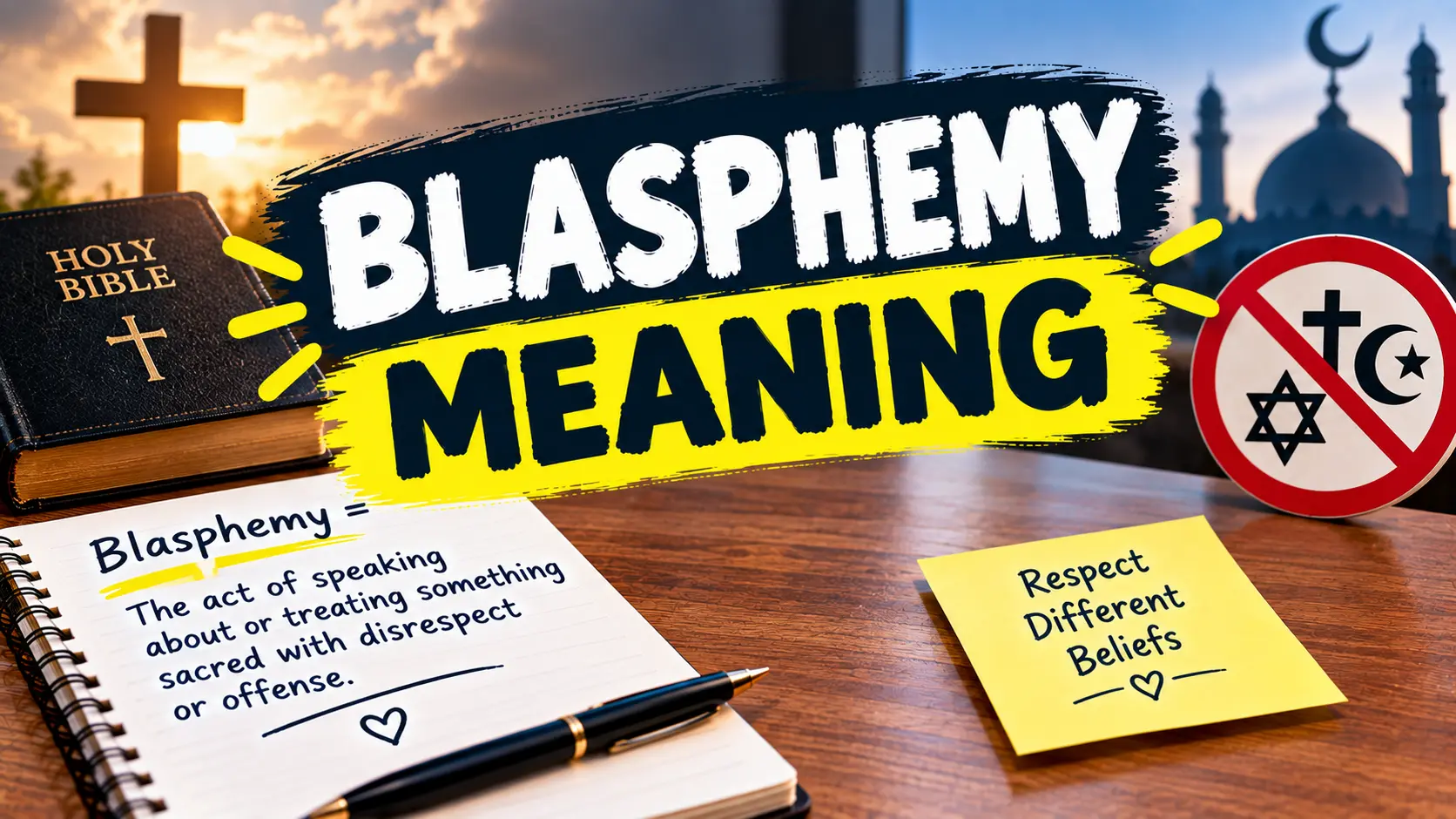
The blasphemy meaning at its core describes speech, writing, or an action that shows contempt or irreverence toward God, a deity, or something considered sacred within a religious tradition. It’s one of the oldest concepts in religious and legal history, and it still shows up regularly in news coverage, legal debates, and even casual conversation today.
This guide covers the full blasphemy meaning across different religious traditions, how it’s treated legally in different parts of the world, the more lighthearted way the word gets used outside religion entirely, and the common mix-ups people make when discussing it. The goal here is a clear, respectful, and accurate explanation — not a judgment on any particular belief system.
Table of Contents
Blasphemy Meaning: The Core Definition
At its most basic, blasphemy refers to words or actions that are considered irreverent, insulting, or disrespectful toward God, a religious figure, or sacred beliefs and objects. The exact boundaries of what counts as blasphemous vary significantly depending on the specific religious tradition and cultural context involved.
The word comes from the Greek “blasphemia,” meaning slander or evil speech, which entered English through Latin and Old French before settling into its modern religious usage.
It’s worth noting upfront that the blasphemy meaning isn’t fixed or universal — what one religious community considers deeply offensive, another may not view the same way at all, and definitions have shifted over centuries within the same traditions.
Blasphemy Meaning Across Religious Traditions
Since the concept plays out differently depending on faith, here’s a neutral, factual overview of how a few major traditions generally approach it:
| Tradition | General View of Blasphemy |
| Christianity | Historically viewed as speaking irreverently about God, Jesus, or sacred texts; specific views vary widely across denominations |
| Islam | Generally considered a serious offense, particularly regarding statements about God, the Prophet Muhammad, or the Quran; the severity of consequences varies by country and interpretation |
| Judaism | Historically tied to specific prohibitions, such as certain uses of God’s name; interpretations vary across branches of Judaism |
| Hinduism | Less centered on a single unified concept of blasphemy, though disrespect toward deities or sacred texts can still be viewed as offensive within specific traditions |
This table is meant as a general, factual overview rather than a complete theological breakdown — each tradition contains significant internal diversity of belief and practice.
Blasphemy and the Law
The blasphemy meaning also carries legal weight in many parts of the world, though the specifics differ enormously by country.
- United States — Blasphemy laws largely aren’t enforceable due to First Amendment protections on free speech and religious expression, even though a few outdated blasphemy statutes technically remain on some state books unused.
- United Kingdom — Common law offenses of blasphemy and blasphemous libel were formally abolished in England and Wales in 2008.
- Countries with active blasphemy laws — A number of countries, particularly in parts of the Middle East, South Asia, and North Africa, maintain blasphemy laws with serious legal consequences, including in some cases criminal penalties.
This is a genuinely complex, evolving legal area globally, and specifics change over time — anyone researching a particular country’s current blasphemy laws should look to updated legal sources rather than assuming historical rules still apply.
Blasphemy vs. Similar Religious Terms
People often confuse blasphemy with related but distinct concepts.
| Term | Meaning | Key Difference |
| Blasphemy | Irreverent speech or action toward God or sacred beliefs | Focused specifically on disrespect toward the divine |
| Sacrilege | Violation or disrespect of something considered sacred, often objects or spaces | Broader — can apply to places, objects, or rituals, not just speech about God |
| Heresy | Holding or expressing beliefs that contradict established religious doctrine | About incorrect belief, not necessarily disrespectful intent |
| Apostasy | Formally abandoning or renouncing a religious faith | About leaving a religion entirely, not offensive speech |
| Profanity | Casual disrespectful or crude language, not necessarily religious | Broader term, doesn’t require religious context |
Blasphemy and heresy get mixed up most often — the key distinction is that heresy is about believing something considered doctrinally wrong, while blasphemy is specifically about showing disrespect or irreverence toward what’s considered sacred.
Blasphemy Meaning in Everyday, Non-Religious Use
Outside religious contexts, the blasphemy meaning has picked up a much lighter, often humorous secondary use — describing something considered outrageous or “sacrilegious” within a specific fandom, hobby, or personal preference, with zero actual religious content involved.
- “Putting pineapple on pizza? That’s blasphemy in this house.”
- “Rooting for the rival team is basically blasphemy in my family.”
- “Skipping the season finale before the mid-season episode? Blasphemy.”
- “He said he doesn’t like coffee — pure blasphemy.”
- “Calling it a ‘soda’ instead of ‘pop’ is blasphemy where I’m from.”
This casual usage works because it borrows the intensity of the original religious meaning — treating something as an unforgivable violation of an unwritten rule — without any actual religious stakes involved.
Common Mistakes People Make With “Blasphemy”
- Assuming it means the same thing across all religions. What counts as blasphemous varies significantly by tradition and even by denomination within the same religion.
- Confusing it with heresy. Heresy is about incorrect belief; blasphemy is about disrespectful speech or action toward the sacred.
- Assuming blasphemy laws are the same everywhere. Legal treatment ranges from fully decriminalized to carrying serious criminal penalties, depending on the country.
- Using the casual, joking version in a context where it could genuinely offend someone. The lighthearted “that’s blasphemy” joke about pizza toppings doesn’t always translate well if used carelessly around genuinely religious topics or audiences.
Quick Summary: Blasphemy Meaning at a Glance
| Question | Quick Answer |
| What is the blasphemy meaning? | Speech or action showing irreverence or disrespect toward God, a deity, or something sacred |
| Where does the word come from? | Greek “blasphemia,” meaning slander or evil speech |
| Is it treated the same across religions? | No, definitions and severity vary significantly by tradition |
| Is blasphemy illegal in the U.S.? | Generally unenforceable due to First Amendment protections, though some old statutes technically remain |
| Can it be used non-religiously? | Yes, often as an exaggerated, humorous way to describe a personal or cultural “unforgivable” preference |
FAQs About Blasphemy Meaning
What is the blasphemy meaning in simple terms? It refers to speech, writing, or actions that show disrespect or irreverence toward God, a deity, or something considered sacred within a religious tradition.
Where does the word “blasphemy” come from? It comes from the Greek word “blasphemia,” meaning slander or evil speech, later adapted into Latin, Old French, and English.
Is blasphemy the same in every religion? No, the specific definition and severity of what counts as blasphemous varies significantly across different religious traditions and even within denominations of the same religion.
Is blasphemy illegal in the United States? Generally, blasphemy laws are unenforceable in the U.S. due to First Amendment protections on free speech and religion, even though some outdated statutes technically remain on the books in a few states.
What’s the difference between blasphemy and heresy? Blasphemy involves disrespectful speech or action toward the sacred, while heresy involves holding beliefs considered doctrinally incorrect — the two often get confused but describe different things.
Do any countries still enforce blasphemy laws today? Yes, several countries, particularly in parts of the Middle East, South Asia, and North Africa, maintain active blasphemy laws with legal consequences.
Can “blasphemy” be used in a non-religious, joking way? Yes, it’s commonly used humorously to describe something considered an unforgivable violation of a personal or cultural preference, like an unusual food combination or a controversial opinion.
What’s the difference between blasphemy and sacrilege? Sacrilege is broader and can apply to disrespecting sacred objects, spaces, or rituals, while blasphemy specifically involves irreverent speech or action toward the divine.
Has the legal treatment of blasphemy changed over time? Yes, many countries, including the United Kingdom, have formally abolished blasphemy laws in recent decades, while others still maintain them.
Is blasphemy always intentional? Not necessarily — the classification often depends on the specific religious or legal framework being applied, and definitions of intent vary accordingly.